The 1976 Season, One Unforgettable Act, and the Card That Captured It
Baseball, at its best, has always been more than a game. It has served as a mirror of the country itself – reflecting its triumphs, tensions, and turning points.
On a quiet April afternoon in 1976, during a routine game at Dodger Stadium, the sport paused – not because of a home run or a no-hitter – but because Rick Monday did something instinctive, courageous, and unforgettable.
In a decade defined by uncertainty, protest, and healing after Vietnam and Watergate, Monday’s actions reminded the country that sometimes the most powerful statements aren’t planned. They happen in a heartbeat.
America in 1976: A Fragile Moment
The year 1976 carried weight. It was the nation’s Bicentennial – a celebration layered with unresolved emotion. Patriotism and protest often stood uncomfortably side by side. Stadiums, like college campuses and city streets, had become places where broader cultural conflicts occasionally surfaced.
Rick Monday, an outfielder for the Chicago Cubs and a former Marine Reserve member, understood something about service, sacrifice, and symbolism. But even he could not have anticipated how sharply those ideas would converge on April 25, 1976.
The Moment That Stopped the Game
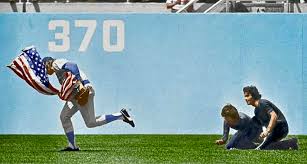
As the Cubs played the Los Angeles Dodgers, two individuals ran onto the outfield grass carrying an American flag and lighter fluid. Their intent was unmistakable.
Before umpires, security, or players could react, Rick Monday sprinted toward them. He snatched the flag from their hands, cradled it, and ran off the field as the crowd erupted.
It lasted seconds.
It echoed for decades.
Monday later said he didn’t think – he reacted. That may be true. But reactions often reveal character more clearly than speeches ever could.
Not a Political Act – A Human One
What made the moment endure was not politics, but instinct. Rick Monday didn’t pause to calculate optics or consequences. He saw something he believed deserved protection—and he acted.
Dodger Stadium, usually animated by cheers and jeers, transformed into something else entirely. Applause poured down, not for a play, but for a principle.
In an era when baseball players were rarely viewed as cultural figures beyond the field, Monday crossed an invisible line. Not as a protester. Not as a spokesman. But as a citizen.
Rick Monday the Ballplayer
It would be a mistake to remember Rick Monday only for that moment.
He was the first overall pick in the inaugural MLB draft in 1965, a reliable outfielder, a World Series champion with the Dodgers, and a respected presence in clubhouses for nearly two decades.
But baseball history has a way of selecting a single frame – a frozen image – that defines a legacy. For Rick Monday, that frame isn’t a swing or a catch.
It’s a man running with a flag.
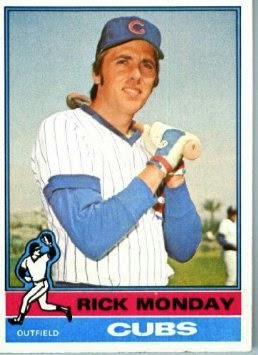
The 1976 Topps Rick Monday Card: Cardboard as History
The 1976 Topps Rick Monday card doesn’t depict the moment. There’s no flag, no crowd, no urgency in the image. And yet, it is inseparable from that season.
That is part of its power.
Topps’ bright, clean 1976 design – released during America’s Bicentennial year – feels almost symbolic in hindsight. Red, white, and blue framed a set that unknowingly housed one of the most meaningful cultural artifacts of the decade.
Why This Card Resonates Today
• Historical crossover – sports, patriotism, and American identity
• Cultural relevance – frequently cited in documentaries and retrospectives
• Set significance – the Bicentennial Topps release
• Collector appeal – undervalued relative to its story
In a hobby increasingly driven by serial numbers and short prints, the Rick Monday 1976 Topps card reminds collectors why context matters.
This isn’t just a baseball card.
It’s a chapter of American history – printed on cardboard.
Baseball doesn’t often ask its players to represent anything beyond the game. But once in a while, the moment chooses them anyway.
Rick Monday didn’t set out to make history. He simply did what felt right. And in doing so, he reminded us that baseball – like the country it reflects – is at its best when it responds with integrity.
His 1976 Topps card endures not because of rarity, but because of resonance. It stands as a quiet witness to a day when the game paused, the crowd rose, and one player reminded America who it hoped to be.