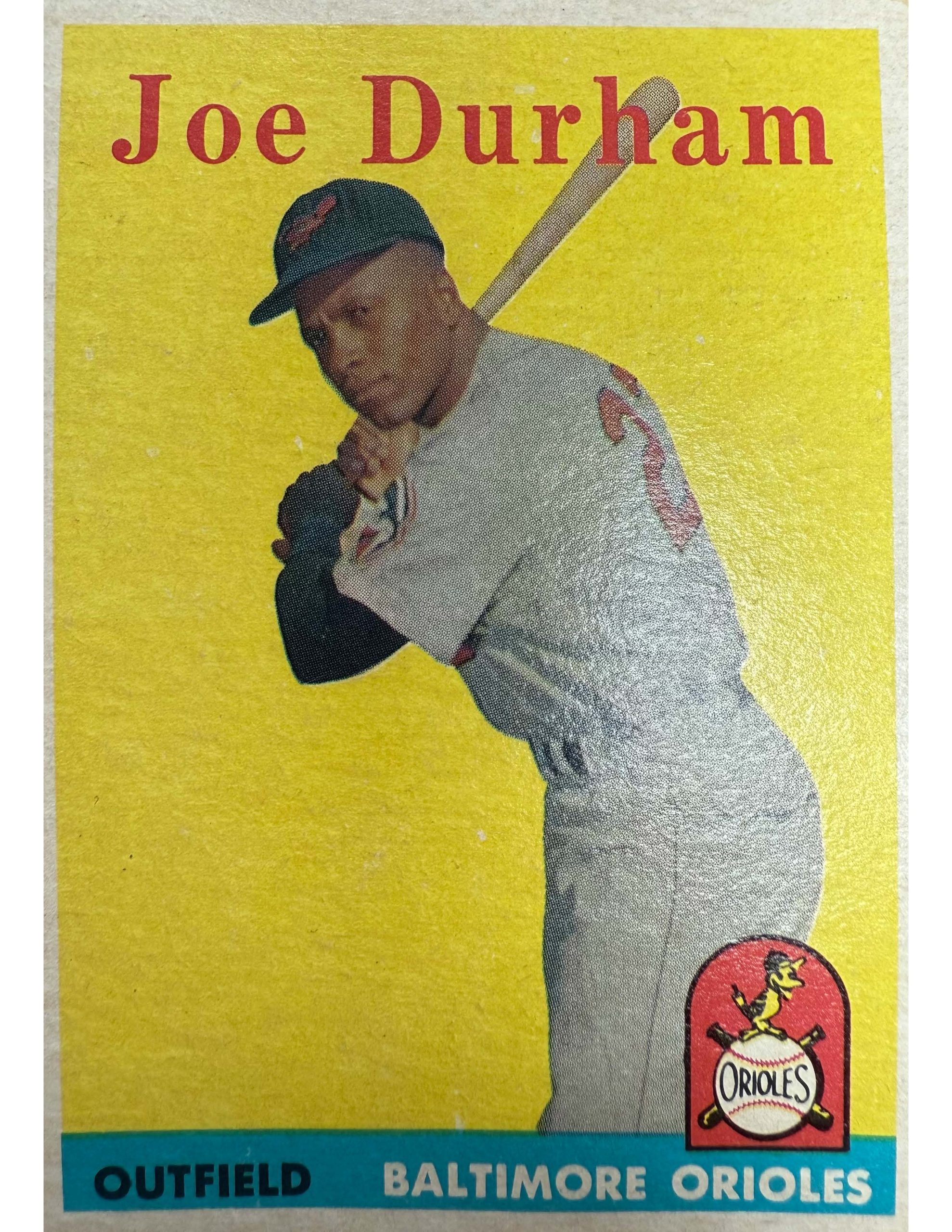
There are players whose names echo through stadiums long after they leave the game—Ruth, Robinson, Clemente. And then there are men like Joe Durham, whose impact whispers instead of roars, carried quietly on the breeze through an empty ballpark long after the lights have dimmed.
Durham didn’t break records. He didn’t win MVPs. But what he did do—what he endured and overcame —paved a smoother road for the generations who would follow. His story is one of resolve, of grace, and of the subtle kind of heroism that baseball, at its best, so beautifully reveals.
And for collectors today, his 1958 Topps rookie card stands as one of the most overlooked tributes to a man who helped the game grow into what it is now.
Joe Durham: A Quiet Trailblazer in Baltimore
In 1954, when Joe Durham stepped onto a major league field for the first time, he was doing more than chasing a dream—he was rewriting a script.
Three years earlier, the great Monte Irvin had told reporters that baseball was changing too slowly, that Black players deserved more opportunities, more visibility, more respect. Durham became part of that change. As one of the early African American players for the Baltimore Orioles, he took his place in a lineup—and a moment—larger than himself.
Durham possessed real tools: quick hands, smooth footwork in the outfield, a graceful natural athleticism reminiscent of a young Sam Jethroe. But talent alone doesn’t always define a player’s legacy. Sometimes, it’s what they represent that matters more.
Service Before Spotlight
Joe Durham’s baseball career paused abruptly when he was drafted into the U.S. Army. Many promising players of that era—Willie Mays, Whitey Ford, Ted Williams—lost seasons to military service. Durham lost something more fragile: momentum.
When he returned, the Orioles had evolved. Lineups had shifted, coaches had changed, and the unforgiving nature of major league competition meant Durham had to fight not just for a roster spot, but for relevance.
He did it with dignity. And he did it with a smile.
A Legacy Beyond Statistics
If you search the stat sheets, you won’t find Joe Durham atop any leaderboard. But if you speak to the Baltimore community—or fans who remember Memorial Stadium in its early days—you’ll find a different truth.
They’ll tell you Durham represented hope.
They’ll tell you he carried himself like someone who loved the game more than what it could give him.
And they’ll tell you that in a turbulent America, he became a symbol of what baseball could still be:
A unifying force.
Durham eventually transitioned into coaching and player development, serving in the Orioles organization for decades. His fingerprints are still there—in the dugouts, in the scouts’ boxes, in the countless players he mentored.
This is the part of baseball history that doesn’t always make the highlight reels. But it should.
The 1958 Topps Rookie Card: A Piece of Baseball History
There are rookie cards that explode in value because of performance. Then there are rookie cards whose worth grows because of what they represent.
Joe Durham’s 1958 Topps #472 Rookie Card belongs to the latter category.
It captures a man standing at the intersection of change—not just in baseball, but in the country itself. With the soft pastels and iconic layout of the ’58 Topps design, the card feels like a window into a different America.
For collectors, this card is more than cardboard.
It’s a tribute to a player who played with integrity at a time when integrity was often all he had.
Why This Card Matters Today
• Historical significance — early African American Oriole
• Scarcity in high grades — many copies were mishandled, and centering issues make PSA 8–9 highly desirable
• Cultural value — ties to the civil rights era and baseball’s slow march toward integration
• Low awareness — still undervalued compared to players of similar impact
In a hobby now overflowing with flashy parallels and ultra-modern refractors, the Joe Durham rookie stands apart—a quiet, dignified reminder of baseball’s journey and the men who helped shape it.
For the thoughtful collector, it might be one of the most meaningful late-1950s rookie cards available today.